The article below provides very important point to consider when it comes to business strategy , decision making and leadership. It looks at how open source initiatives demand for a change in the leadership and decision making is done from profit or stakeholders gain to votes and views from contributors or in my own view those people who actually had contributed in the development of open source projects.
In my experience, some projects that I had worked with failed to achieve its goal simply because the views of those who had worked hard in the project had been ignored by managers that only focused to feel the stakeholders view.
Taking some of the learning point in the article below, open collaboration must be guided with clear intention to achieve the success of the project. And not to succumb to pressure from a small group of stakeholders.
I shall not dwindle too long... the article below explains it all.
The Promise (and Perils) of Open Collaboration
Posted using ShareThis
Yup, never stop learning. In the case of Malaysia, we simply don't learn. Fed Government spent a lot of time, resources and money simply yo make our roads safer. Deaths on the road is just another news and seems to be a daily phenomenon, as if that our country is at war. For this year's Ops Sikap, a total of 241 deaths (NST, 2009). Hmm, within a short span of time, the deaths is almost as much as in Iraq or Afghanistan.
Can we do something about it? Well, you tell me or better still let's see this vide and reflect... oh ya, ignore the insurance add... see, do and act...
This is a video from Australia about road safety. I know that road accidents in Australia is not as bad in Malaysia. Remember the recent Ops Sikap... duh!
Watch and reflect
Knowledge and power has a direct co-relation as with knowledge one has power over other with lesser knowledge.
However, it may also work to the one's disadvantage, especially when the knowledge is used negatively. For example when ones missues ones knowledge for the wrong reason.
This is a reflection from a meeting I had today. My goal for the meeting was to justify for an IT project for my department. My proposal was about implementing a collaboration tool for my organisation.
One of many points and concern raised by the evaluation committee was whether existing collaboration tools is frequently used by the staff and that by adding a new tool would be of any value. So, he asked members of the meeting with intent to acquire their view on the existing collaboration tool usage.
To my surprise, a few young managers who are of generation 'x' mentioned that they rarely use any of the organisation's collaboration tool. Not only that, one of them openly said that he's lost his desire to attend training due to the organisation's learning management system. Another young officer who claimed that she is from an IT brackground finds little value of the collaboration tools in her work.
In my view, the knowledge from the young managers are valueable to me and my team. From one perspective, theses young managers seems to have power over me and my team as they raised the visibility on the flaws and weakness of the systems under my purview.
However, the point of time when the knowledge was conveyed was very untimely and adds little value to the cause of the meeting. Perhaps it would be of more value if the young managers can share their view and knowledge with me and my team before this meeting or in another time or forum. In this situation, little they realise that their knowledge could be of more value if they had used or leverage on correctly. In this case, it is a reflection of their own ignorance to the greater cause of a knowledge based organisation.
I'm no generation 'y', just happen to be there...
One of my deliverable for this year is to revisit the e-learning strategy that my department had come up with a few years back. I agree that revisiting the strategy is important. One should step back and reflect whether the strategy is valid or not.
the e-learning strategy that my org has was introduced in 2004. The strategy not only covers e-learning but the holistic view of learning through the use of technology. I don't have any argument about the strategy's breadth nor depth of the strategy. i'm concerned that to date, its implementation and adherence to the strategy was not as it should have been.
Perhaps, for this year's deliverable, I should just give my opinion and and stance on the strategy plus a reflection to what has been done so far...sort of a reality check...
I'll share the strategy doocument is slide share soon.
The LMS has many capabilities. In my case, the organisation is using Sumtotal TotalLMS. So, I'll be sharing bit by bit on how we can do a learning course design on the LMS itself. Watch this space... I'll be back
Last year, I heard one of my colleague asked me about transferring a video tape, a mini DV actually, in to a DVD. Immediately I reflected upon my days in Melbourne. I actually did that with my mini DV Camcoder after me and the family went out for an outing to the scenic Melbourne and outer Melbourne.
It was a tedious process and requires specific hardware and tools in order to do so. During that time, I used a firewire cable to connect the camcorder with my notebook. I was lucky to have a built in firewire port so I can straight away transfer the video. The transfer process also demands a lot of memory resources and a large disk space. So, RAM is at least 1 GB and free space of at least 40GB. For a PC, a firewire card is required, if not, the video cannot be transferred to the PC.
As for software, Pinnacle Studio is the best! Easy to use and the output is almost professional! The only challenge is that the video transfer will take as long as the video it self. If it is a 60 minutes video, then the transfer will take the same time to be transferred to the disk.
Now, one does not need to have a firewire card. Thanks to USB, we cannow use a USB video capture device. Just like the one that we have in the office. The model name is Pinnacle DVC 150. This is an older model that we have. By using this device, we just need to connect the camcorder to the DVC, then the DVC can be connected directly to a computer or to a VCR or a DVR. One prevalent advantage of using the USB DVC is that the conversion is done in the device it self and not one of our office. Therefore, the computer's resources will not be affected too much during the conversion stage. So, the risk of PC to crash or simply frozen is now reduced.
There are now a lot of USB devices like the Pinnacle DVC. In Lelong.com.my, the termed as usb video grabber.
Wanna know more, I'd be glad to show you how to do it :)
We got a lot of techie good stuff to use, but we fear them even before we even touch or know more about them. Why? Is this a learning issue? Environmental issue? The notion 'we fear what we do not know' highlights one key element in relation to fear. Knowing! Tinker, tinker, tinker...
LOL [means Laughing Out Loud], lets see whether my topic is going to get some discussion here. I first encountered the word baby boomers when I was in Melbourne for my postgrad degree. One of my fellow master candidate talked about the impact on the whole social and economic impact when she and other people are retiring in a few more years. Not to mention that she was made redundant from he job with just a few more years to retirement. Well, she succeeded to survive the storm and now working for Anecdote Australia.
What does the story got to do with the topic, nothing much just an intro. Recently, the word baby boomer that I now hear most of the time is associated to the matters related to usage of technology. Most of the time it was a comparison with the younger generation, namely gen-x and gen-y. And, in this context, baby boomers are associated to their lack of either interest about technology or that they are not interested about technology. Is this a fact? I want to know for sure.
So, as a typical gen-x, I simply hit the keys into the 'crystal ball' called Google, ... tehehe... just kidding, to find some answer. Want to know what I found? Just click on the link below :)
Although there's been a lot of talk over the last decade about the importance of creating technology for Baby Boomers, the conversation has largely focused on the size of their population, their characteristically different behavior than previous generations (throughout their lives) and the amount of disposable income they have available. When working on the Whirlpool in.home project last year, I realized that there was another compelling reason why design for Baby Boomers is important: their familiarity with computer technology.
http://www.orangecone.com/archives/2006/07/baby_boomers_an.html
If the above is not intriguing, try the one below ;)
HDTV Tops Baby Boomers’ Technology Wish List
February 10, 2009 — boomersummit
Baby boomers’ love affair with technology continues and they plan to keep buying new technology.
http://boomersummit.wordpress.com/2009/02/10/hdtv-tops-baby-boomers-technology-wish-list/
Well, baby boomers are really tech savvy after all!
So then, arguments on baby boomers not really keen with technology or dislike technology may not be true...I don't know... maybe a baby boomer can share his/her view...
Besides, I'm a gen-x :)
Have you ever been asked to convert a document to PDF and Adobe Acrobat is not installed in you pc? Do you know how expensive is Adobe Acrobat? It is expensive, seriously.
Unless for those lucky few who bought a scanner or a multifunction printer, then the manufacturer may bundle in Acrobat with the printer. So, many actually turned to the internet and download many of those time limited software that converts their file to PDF. However, these software would stamp words like "This document is converted by something-something" and it does not look nice at all.
So, I stumbled upon an open source tool called PDF Creator that helps me to convert files in to PDF format easily.
It is simple to use, all you need to do, after installing the software, is to use the Print function and select PDFCreator as your intended printer. Then just click Print to proceed.
Here are the step-by step guide on how to use PDF Creator. Cheerio!
- Firstly, very important, download PDF Creator from sourceforge.net here
- Upon completion, install the software.
- Ok, to demonstrate just open any file or website. Select File>Print

- Select PDFCreator as printer, click Print

- A pop up will appear, type in the preferred title for the pdf in the title box

- Then, another pop up will appear asking you to type a file name for your PDF

- Done.


Other references can be found here:
- Pdfcreator official site, http://pdfforge.org/
- “PDFCreator | Open Source Alternative - osalt.com,” http://www.osalt.com/pdfcreator.
My team is on leave, including my IT support. So, it's my time to do the techy workwhereby my colleague Connie usually does it.
One of the TM called me up and mentioned that she can't "register others" for a course, hmmm what was wrong with the batch registrations. So, I went into the role management module and noticed that the under CanManageOtherRegistration, Add to Roster, Remove from Roster and Edit was not selected. So, I experimented first by selecting Edit but TM cannot do batch registrations. So, then I selected on all three and it works!
Click on the image below to view the settings.
Since the LMS is up, the password problem issue suddenly pops up and I'm feeling like I'm back to square one before the systems is enhanced. Well to comfort myself, I can always say that this is normal as we are still in the enhancement mode and there are bound to be teething problem after we put the application to the real production environment.
Well, I intend to talk about the LMS enhancement later in the blog, strictly from a KM perspective.
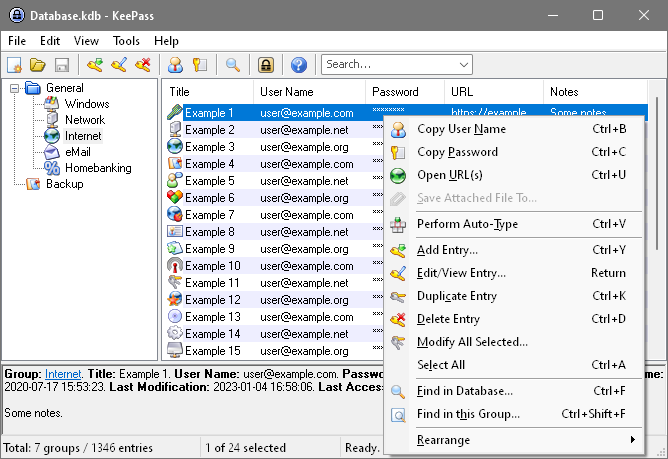
Now, back to the password issue, I've been using this tool called keepass since 2 years ago. Keepass is an open source software, which means that it is free to use :)
The security feature that comes with the tool is something that makes me comfortable using it. The database is well encrypted using the using secure encryption algorithms known as AES and Twofish.
Another feature that makes the tool handy is that it is portable and can be run on even a thumbdrive. This is made possible by creating a key file in a thumbdrive and keepass will refer to it for authentication before accessing the stored password.
If you neeed further info on the tool and how to use it, just go on and visit the site at http://keepass.info, and if you are interested to know more about how u can use applications from your thumbdrive, go to http://portableapps.com/
Been bz with a few user acceptance testing (UAT) recently. It has been awhile since I last performed a UAT, come to think of it has been 4 years ago since my last UAT.
Not to say that I was happy to be doing it but I was surprised on the manner the UAT which I'm currently undergoing. It seems like the end users were not directly involved in the UAT. I'm the departmental rep, a coordinator like role who translate the business requirements to the software vendor. The real owner of the requirements are the biz users or as we termed it as process owners.
By right it is them to do the UAT together with me since they are the process owners who knows best their business requirements. So, I argued that I need my business people to test the system together with me, the coordinator, but was received strong objections from our technical unit.
So, I just let it be thinking that perhaps I was wrong. Nonetheless I managed to do some research to suppress my curiosity on the subject as well as to self assure that I was correct in arguing my case on the approach of the UAT
So, here are some of the sources I found on the net on the UAT.
Cheerio.
- “What is User Acceptance Testing?,” http://www.exforsys.com/tutorials/testing/what-is-user-acceptance-testing.html.
- “Acceptance testing - Wikipedia, the free encyclopedia,” http://en.wikipedia.org/wiki/Acceptance_testing.
 Question now is how does this will impact Malaysia's aspiration in the K-Economy? Electronic and mobile banking? E-learning? Collaboration?
Source:
Oh yes, we're not alone... what am I mumbling about... A couple of weeks ago, sometime in December 2007, had an opportunity to drop by at the Malaysian Employees' Provident Fund's (EPF) Knowledge Fair. My workplace too had a Knowledge Fair in 2006 and we were supposed to have one in 2007 but couldn't as I was shorthanded and over occupied with other projects at the KM Centre (KMC). Thanks EPF's KM officer, Mr Farris was kind to show me around the fair.
The setting of the fair was made at their headquarters' ground floor lobby. Based on my observation, there were around 10 to 12 booths exhibiting various aspects on KM in EPF. There was a booth showing the various technology EPF has adopted over the years; one that interest me was how storage technology has changed over the years, from the big-o tape to hardisk, from megabytes to terrabytes. I guess why this is important to EPF is that the number of members contributing to their fund is increasing each single day. Hence a big storage size is really important for them. But not as important their PEOPLE!
This was how the EPF team positioned KM. It all began with people as knowledge is about people. How true... Kudos to Farris and team. Will put more insight on KM in EPF in contrast to my own organisation soon.
Signing off...
Opps.. the title seems intriguing indeed. Yes, I've been missing for so long... Since I returned from studies it has been a rough ride back to work. Especially when some people my organisation deemed us who went to further our studies as "going on a honeymoon", makes it harder to fit in back. Ah well, though I'm no chameleon, I think I did well so far. Yes, I'm down but that doesn't mean that I'm defeated. Yes, it's a war zone here.
The state of KM in my organisation is also resembles the subject of this writing piece. It's down but I don't really think that it's dead. Not yet. The KM unit in my organisation is really short of staff. 2 lower management is full time on projects and much of the unit's administration and reporting job are under their direct responsibility. A couple of executives like myself is torn apart into multiple projects and ad-hoc assignments with little support and guidance from our supervisors.As a result, many task we done blindly without guidance and support from the lower management causing us to get "shot" when the middle management were to review our progress. It may get worst when our own supervisors also to took the opportunity to "gun" us down too in front of the middle managers.
My own reflection here is that, for the practice of KM to flourish, there should be consistent support from the top and middle management to foster teamwork, collaboration, continuous improvement and etc. The path of punishing and downgrading oneself should not happen at all. If it does happen then this may be one of the first signal of a sick organisation.
A lot of people I met when we talk about KM mostly focused KM in large or big sized organisations. Not many spoke about KM in small business and its relevance. Maybe due to the small size, the organisation could easily manage its knowledge. Yes, if its own tacit knowledge and explicit knowlede, yet to some extent! Usually KM implementations are done by developing a KM system or implementing an IT tool for the organisation. This is usually very expensive and beyond the reach of small businesses. As a result, small businesses do not see KM relevant theme for their business.
KM can hekp small business in many ways that do not require them to implement expensive solutions. Some of the examples of KM job for small business would be:
1. Knowledge mapping - this would include mapping out of the business operational knowledge and flow, knowledge maps of internal resources and external resourcesThe list can go on and on. But the most important thing for KM practitioners is to provide a balance view of what KM is all about. Which is more than IT, technology and data. It's all about human. If business fail to recognize this, then they fail to recognize their own valuable assets.
2. Strategic planning
3. Human development
4. Process management
One of my uni mates asked what course I'm doing, I replied Knowledge Management. I could see clearly that he's grappling in his mind, what is knowledge management (KM). Then he asked me, can we manage knowledge since it is very much in the head? I told him, yes we can manage knowledge but it is not easy to do. He smiled...
Indeed, managing knowledge is difficult. Where I work in Malaysia, the organization has a comprehensive KM framework, covering both human and technological aspects. However, after almost 6 years of implementing KM, we are still struggling.
The organization has provided excellent infrastructure such as email, electronic forums, intranet, database systems and meeting rooms to promote sharing of knowledge. This is really good as I've seen good contents on the intranet, our databases are filled with data and a lot of documents are shared on the servers. However, those are more to explicit knowledge transfer/creation.
One problem that I realised about my organization is that the 'knowledge culture' is yet to flourish. Maybe due to the highly political background of the organization, but also due to the negative culture that has been within the organization for a very long time. For example, blaming is notoriously practiced there. Peter Senge did mention about this and blaming should stop for organization to succeed in managing its knowledge.
Another problem is that my workmates sometimes complained that there's no time for chit-chat which in turn limits the socialisation required to transfer tacit knowledge.
I'll stop here first to see if there's any feedbacks.
Have a productive k-day! :)